Refined Digital Insight Inc.

Author name: rdi-admin

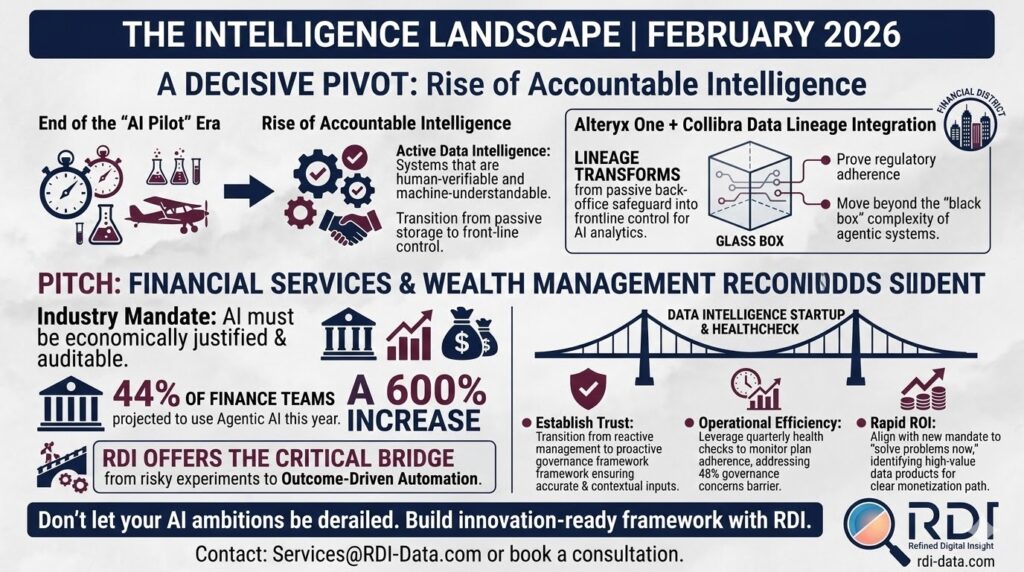
The intelligence landscape of February 2026 has been defined by a decisive pivot: the end of the “AI Pilot” era and the rise of Accountable Intelligence. As enterprises grapple with the Trust Paradox, the focus has shifted from merely storing data to creating Active Data Intelligence—systems that are human-verifiable and machine-understandable.

A landmark development this month is the integration of Alteryx One and Collibra Data Lineage, which transforms lineage from a passive back-office safeguard into a frontline control for AI analytics. This “glass box” approach allows leaders to prove regulatory adherence and move beyond the “black box” complexity of agentic systems. In high-stakes sectors like finance, leaders are prioritizing AI observability and data literacy to bridge the skills gap, recognizing that an AI decision is only as valuable as the automated lineage that explains it.
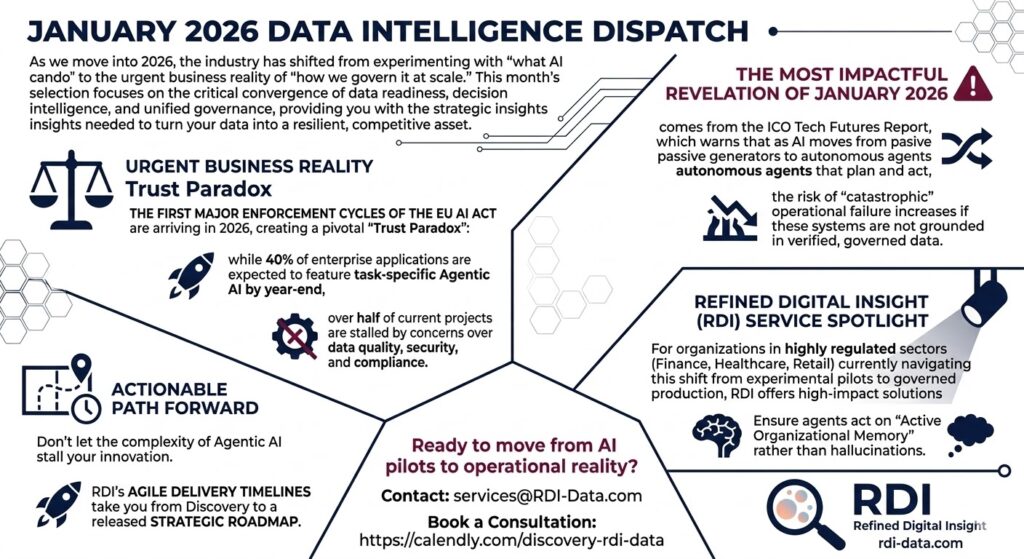

The January 2026 Data Intelligence Dispatch highlights the industry’s shift from experimental AI to the operational reality of governing autonomous systems at scale. The newsletter centers on the “Trust Paradox,” where the demand for Agentic AI is outstripping organizational data readiness and AI literacy, making Unified Governance—as validated by Collibra’s leadership in the Gartner Magic Quadrant—the essential bridge for success. Key themes include the transition of data from passive storage into Active Organizational Memory, the rise of Decision Intelligence to orchestrate business outcomes, and the critical role of automated, column-level lineage in meeting the first major enforcement cycles of global regulations like the EU AI Act. Ultimately, the edition underscores that 2026 value is driven by packaging data into governed products and implementing AI observability to ensure that automated decisions remain accurate, unbiased, and transparent.

The December 2025 Data Intelligence Dispatch highlights a critical shift from experimental AI to **Agentic AI governance**, focusing on the infrastructure required to manage autonomous agents at scale. The newsletter centers on the move toward **semantic interoperability**, exemplified by the **Collibra and Snowflake** partnership to create a vendor-neutral semantic framework that eliminates “translation debt” across cloud ecosystems. Key themes include the necessity of **AI-Ready Lineage** for regulatory compliance and auditability, the closing of the “Governance Vacuum” as tech leaders transition from ad-hoc risk mitigation to systematic trust frameworks, and the evolution of the data catalog into an **active marketplace**. Ultimately, the edition emphasizes that 2026 success will be defined by **computational governance** and the strategic pruning of data assets, turning data management from a technical overhead into an automated engine for workflow transformation and measurable ROI.

The November 2025 top articles confirm that data governance is shifting from passive compliance to an active enabler of AI innovation and cost optimization. The critical trend is maximizing ROI by leveraging tools like Collibra’s new data usage feature, which intelligently prioritizes governance efforts on high-value data while cutting cloud costs. Furthermore, data lineage is now recognized as the foundational layer for AI Explainability and trustworthiness, essential for complying with emerging regulations like the EU AI Act. Successful data initiatives are embracing a data-centric approach to AI, prioritizing data quality and cataloging to ensure accuracy for new models. Ultimately, the focus is on achieving complete lineage and strict data security to empower business users and accelerate time-to-insight across the enterprise.

The October 2025 Data Intelligence Dispatch focused on the convergence of data governance, data lineage, and data catalogs as the essential foundation for scalable, trustworthy AI initiatives. A key theme was moving beyond the impractical goal of “governing everything,” highlighted by **Collibra’s new Data Usage capability**, which provides data teams with usage metrics to strategically prioritize governance efforts on the most valuable, actively consumed data assets, thereby optimizing resources and reducing cloud costs. The newsletter emphasized that modern **AI-augmented data catalogs** are no longer static inventories but dynamic, intelligent systems that, when combined with **data lineage**, unlock tangible business value by accelerating **root cause analysis**, ensuring regulatory compliance (like with GDPR), improving decision-making confidence by bridging the “trust gap,” and transforming data governance from a cost center into a core strategic enabler for new revenue streams and **AI agent development**.

This September, the business world has been put on notice. As highlighted by recent industry analysis, two trends are converging into a massive governance challenge: the explosion of GenAI adoption within the enterprise—with reports showing up to 78% of employees bringing their own AI tools—and the immediate emergence of hyper-specific data regulation, such as the legislative push to protect consumers’ Neural Data.

The message for every organization is clear: Ungoverned AI is your next critical compliance and risk failure point. You cannot afford to scale AI until you can fully trust, track, and audit the data powering it. Businesses are already paying a steep price, with poor data quality costing organizations an average of nearly $13 million annually and non-compliance fines soaring globally.

In the dynamic world of data, the past month has seen significant strides in how organizations are leveraging data lineage, data catalogs, and data intelligence to enhance trust, accelerate AI initiatives, and drive business value. This edition highlights key developments and actionable insights to help you navigate the evolving data landscape with confidence.
Recent research from McKinsey & Company highlights a critical challenge for businesses: the “missing data link” that prevents organizations from scaling their data products. It’s not about having more data; it’s about generating more value from the data you already have. They point to the “flywheel effect” of accelerating value capture and reducing costs with each new business case, but this requires a foundational shift in how data is managed.

In July’s edition of the Data Intelligence Dispatch, a clear theme emerges: responsible AI innovation is only possible when grounded in strong data governance, cataloging, and lineage systems. Collibra’s acquisition of Raito marks a major leap forward, unifying data and AI governance through a single platform that enhances traceability, access control, and model oversight. Across the public and private sectors, organizations are recognizing that trustworthy AI outcomes require high-quality, well-governed data—making metadata management, lineage automation, and AI-enhanced catalogs mission-critical. Key insights this month emphasize how data lineage boosts business confidence, how AI is reshaping both BI and governance workflows, and why global privacy regulations are raising the bar for compliance. Together, these developments position data intelligence not just as an enabler of AI, but as the foundation of enterprise innovation, risk mitigation, and strategic advantage.

The June 2025 edition of Data Intelligence Dispatch highlights the growing urgency for unified data governance as organizations accelerate their adoption of AI technologies. A central theme across the insights is the convergence of data lineage, cataloging, and AI governance as foundational pillars for trusted, scalable, and compliant AI systems. Collibra’s emphasis on “The Power of One” reflects a broader industry movement toward integrated platforms that manage both data and AI assets holistically. Articles throughout the edition stress that AI governance must evolve from existing data practices, not diverge from them, with metadata management, data quality, and lineage all playing critical roles in transparency, risk reduction, and decision-making confidence. In parallel, the rise of AI-powered data catalogs and the resurgence of lineage-driven intelligence signal that automation and traceability are no longer optional—they are strategic imperatives. As regulatory environments tighten and AI transforms enterprise workloads, robust data governance is the linchpin enabling responsible innovation and long-term competitive advantage.

The Importance of Data Intelligence Processing and Analytical Reporting In todays digital-first world, data isnt just an asset; its the lifeblood of modern organizations.From strategic decision-making to uncovering hidden opportunities, the ability to process data intelligently and transform it into actionable insight.

Scroll to Top