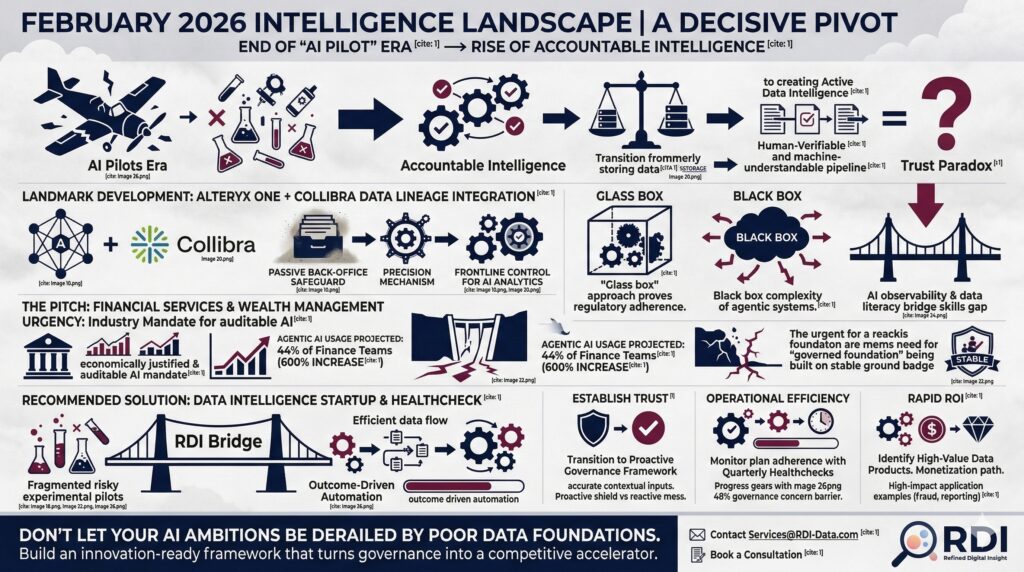
The intelligence landscape of February 2026 has been defined by a decisive pivot: the end of the “AI Pilot” era and the rise of Accountable Intelligence. As enterprises grapple with the Trust Paradox, the focus has shifted from merely storing data to creating Active Data Intelligence—systems that are human-verifiable and machine-understandable.
A landmark development this month is the integration of Alteryx One and Collibra Data Lineage, which transforms lineage from a passive back-office safeguard into a frontline control for AI analytics. This “glass box” approach allows leaders to prove regulatory adherence and move beyond the “black box” complexity of agentic systems. In high-stakes sectors like finance, leaders are prioritizing AI observability and data literacy to bridge the skills gap, recognizing that an AI decision is only as valuable as the automated lineage that explains it.
Refined Digital Insight (RDI) Service Spotlight
The most accessible and urgent segment within this narrative is the Financial Services sector. Financial institutions are currently facing an “Industry Mandate” where AI must be economically justified and auditable. With 44% of finance teams projected to use agentic AI this year—a 600% increase—the demand for a stable, governed foundation has reached a breaking point.
Refined Digital Insight (RDI) offers the critical bridge for these institutions to move from risky experiments to Outcome-Driven Automation.
Actionable Path Forward
For finance leaders struggling with the 89% of AI pilots that fail to operationalize, RDI’s Data Intelligence Startup service provides the necessary “Foundational Setup” for robust data governance. This service aligns short-term business goals with a data-centric, compliant framework that is essential for high-impact applications like fraud detection and automated regulatory reporting.
- Establish Trust: Transition from reactive management to a proactive governance framework that ensures AI inputs are accurate and contextual.
- Operational Efficiency: Leverage quarterly health checks to monitor plan adherence, addressing the 48% of leaders who cite governance concerns as their top implementation barrier.
- Rapid ROI: Align with the new mandate to “solve problems now” by identifying high-value data products and establishing a clear path to monetization.
Call to Action
Don’t let your AI ambitions be derailed by poor data foundations. Let RDI help you build an innovation-ready framework that turns governance into a competitive accelerator.
Contact Services@RDI-Data.com or book a consultation
1. Collibra & Alteryx Tie-Up: Lineage as a Frontline Control for AI Analytics
Business Driver: Mitigating the “black box” risk of AI-driven analytics by providing end-to-end transparency for non-technical business users.
Key Takeaway: Data lineage has graduated from a back-office audit tool to a proactive risk management control, ensuring that AI-generated insights are backed by certified, high-quality data.
Summary: Published on February 27, 2026, this integration represents a major leap in data intelligence. By surfacing Collibra’s enterprise-grade lineage directly within Alteryx’s analytical workflows, organizations can now prevent “poisoned” data from entering AI models. This “governance at the point of consumption” empowers analysts to trust automated outputs because they can instantly trace the origin and transformation history of the underlying data.
Link: Alteryx–Collibra Tie-Up Turns Lineage Into A Frontline Control For AI Analytics
2. Gartner® 2026: The Shift from Compliance Checkboxes to Production AI Readiness
Business Driver: Accelerating time-to-market for AI products by replacing manual governance gatekeeping with automated, code-driven safeguards.
Key Takeaway: The latest market evaluations prioritize vendors that offer “Active Metadata”—systems that use AI to govern data in real-time rather than relying on static, manual documentation.
Summary: Released in early February 2026, the new Gartner Magic Quadrant for D&A Governance highlights a critical divide. Legacy tools built for simple compliance are being outpaced by platforms that enable “Agent-Ready” governance. The report underscores that 2026 winners are those who use automation to ensure data is “machine-understandable” at the moment of execution.
Link: What is Data Lineage? Tracking the Journey of Your Data – Atlan
3. Capco’s 10 Imperatives: Operationalizing Agentic AI in Finance
Business Driver: Reducing operational friction and human workload in highly regulated sectors through the deployment of autonomous “Agentic AI.”
Key Takeaway: Agentic AI is moving from research labs to the mainstream delivery lifecycle, but its success depends on “AgentOps”—using AI to enrich metadata and remediate data quality autonomously.
Summary: This February 16, 2026, report outlines how financial services are leading the charge in Bounded Operational Domains. By using AI to handle repetitive governance tasks like anomaly detection and quality remediation, firms are finally seeing the AI ROI that remained elusive in previous pilot-heavy years.
Link: 10 imperatives for Data & AI in 2026 – Capco
4. DataCamp’s 2026 State of Data & AI Literacy: The Human Bottleneck
Business Driver: Closing the “Trust Gap” by ensuring employees have the skills to verify and act on AI-driven recommendations.
Key Takeaway: While 72% of leaders say AI literacy is critical for daily work, nearly 60% report significant skills gaps, making literacy the single largest risk to data intelligence adoption.
Summary: This February 2026 report reveals a stark reality: technology adoption has outpaced human capability. For data catalogs and lineage tools to be effective, they must be paired with literacy programs that teach users how to interpret metadata and question automated outputs, turning the workforce into the final line of defense against AI hallucinations.
Link: 2026 State of Data & AI Literacy Report – DataCamp
5. Why Data Quality is the “Unsung Hero” of AI Reliability
Business Driver: Maximizing the accuracy of Large Language Models (LLMs) by eliminating the noisy, incomplete, or biased data foundations that cause hallucinations.
Key Takeaway: There is no substitute for a strong data foundation; high data density and quality are more important for AI agents than the complexity of the underlying algorithm.
Summary: This February 23, 2026, perspective from industry analysts highlights that as AI moves into production, the margin for error narrows. The report argues that teams are discovering how quickly data inconsistencies undermine user trust, and it advocates for embedding continuous monitoring directly into data pipelines.
Link: Why data profiling is the unsung hero of AI reliability – Collibra
6. Robot Data Lineage: The New Frontier of Automated Traceability
Business Driver: Ensuring accountability and transparency in robotic process automation (RPA) and autonomous physical systems.
Key Takeaway: The market for robot data lineage is projected to explode to $5.23B, driven by the need to track data flows through physical robotics-driven analytics pipelines.
Summary: Published on February 25, 2026, this market report identifies a new niche in data intelligence. As organizations deploy physical robots that make real-world decisions, the need for a clear audit trail from sensor data to mechanical action has become a top priority for liability and safety compliance.
Link: The Robot Data Lineage Governance for Analytics Market 2026
7. Techment: From Dashboard Reporting to Decision Intelligence
Business Driver: Increasing decision velocity by shifting from passive dashboards to intelligent, conversational systems that offer instant forecasts and recommendations.
Key Takeaway: AI analytics is moving toward “Autonomous Analytics Copilots” that replace manual BI, allowing non-technical users to query the data catalog using natural language.
Summary: This comprehensive guide from February 2026 explains why the future of the data catalog is conversational. By providing a “System of Record” for AI-assisted decisions, leaders can reduce their dependency on centralized BI teams and enable departments to innovate at their own pace without sacrificing governance standards.
Link: Top 10 AI Data Analytics Trends 2026 Enterprise Leaders Must Prepare For
8. Retail Banker International: Why Lineage Breaks Before Technology Fails
Business Driver: Avoiding regulatory penalties and reputational damage by being able to explain complex financial outcomes under government scrutiny.
Key Takeaway: Technical outages are rare; the real “collapse” happens when a bank cannot explain an automated credit decision or financial report to a regulator due to broken metadata.
Summary: Published on February 2, 2026, Dr. Gulzar Singh explains why modern data platforms don’t solve lineage on their own. The article warns that when lineage collapses, the impact is rarely a financial “loss” on day one, but rather a “loss of control” that becomes visible—and catastrophic—during a regulatory audit.
Link: Why data lineage breaks before technology fails
9. Citadel Securities: The 2026 Global Intelligence Crisis
Business Driver: Managing the escalating compute costs and infrastructure needs of massive AI scaling.
Key Takeaway: The marginal cost of compute is becoming a “natural economic boundary” for AI substitution; data density and federated computing are now strategic necessities for cost management.
Summary: This February 24, 2026, economic analysis highlights that AI adoption is following an S-curve. For companies to survive the “Intelligence Crisis,” they must focus on data density—extracting more value from existing data assets rather than simply buying more compute power.
Link: The 2026 Global Intelligence Crisis – Citadel Securities
10. Hyperight: Redesigning Governance for the “Corporate Nervous System”
Business Driver: Creating a resilient, machine-led future where data governance acts as the connective tissue for a decentralized organization.
Key Takeaway: We have reached the tipping point where data is consumed more by machines than humans, requiring a shift to “Just-in-Time” entitlements and declarative policy metadata.
Summary: This February 2026 prediction piece describes the transition from governance as a “Function of NO” to a “Catalyst for Scale.” By moving to self-healing data pipelines and autonomous remediation frameworks, organizations are building a digital backbone that can survive schema drift and algorithmic bias without manual intervention.
