The Breakthrough: Overhauling the “AI-Ready Data” Operational Spine
The most impactful framework driving the industry over the past 30 days is the release of the comprehensive 2026 Enterprise Guide to AI-Ready Data. This guide formally dismantles the myth that AI readiness is a platform feature, defining it instead as a strict operational condition.
Why this matters: AI systems are fundamentally literal and context-blind. While a human analyst can infer meaning from poorly documented tables, an autonomous AI agent cannot. To prevent devastating model hallucinations and navigate strict compliance frameworks (like the EU AI Act), data must be delivered with continuous, automated metadata context built-in.
Industry data confirms that moving from traditional static inventories to active metadata platforms reduces pipeline maintenance burdens by 70%. Furthermore, implementing automated column-level data lineage compresses root-cause analysis timelines from an average of 3–4 weeks down to mere minutes, preventing broken upstream data from poisoning downstream AI products.
The Accessible Segment: Enterprise Leaders Stuck in “AI Limbo”
This development directly targets Chief Data Officers (CDOs), IT Executives, and Data Governance Sponsors who have rushed to deploy LLMs and generative workflows but are currently hitting an operational wall. They have the advanced models, but they lack the underlying data engineering discipline, cross-estate policy enforcement, and trusted data lineage to let those models safely run autonomously.
The Pitch: Activating Your AI Data Foundation with RDI
To bridge this operational gap, Refined Digital Insight (RDI) provides the strategic roadmap and active frameworks required to turn raw enterprise data into highly monetizable, AI-ready assets. We meet forward-thinking enterprise leaders exactly where they are.
1. AI Readiness Plan & Enablement Service
For organizations looking to build a secure, technically sound foundation for scalable AI adoption, RDI provides a structured blueprint:
Strategic Alignment: We collaborate directly with your business teams and AI use case sponsors to discover and unify short- and long-term strategic objectives in writing.
AI Ecosystem Maturity Assessment: Our experts evaluate your current data and technology landscape against RDI’s proprietary AI Reference Architecture model to map out enablers and critical gaps.
Robust Framework Creation: We deliver a tailored AI Readiness Framework to guide your sustainable AI strategy, implementation priorities, and cross-functional model governance.
2. Collibra Managed Services: Active Metadata Enablement
If your organization has already deployed a premier data intelligence platform but is struggling to keep up with manual data stewardship, RDI transforms it from a passively maintained platform into an active, continuously delivering capability:
Operations & Metadata Enablement (Tier 2): We automate your data discovery and manage metadata loads using RDI connectors (up to 30 loads per quarter) to ensure your data catalog stays completely fresh and ready for machine-speed reasoning.
Tailored Value Services (Tier 3): We accelerate platform maturity and drive adoption by delivering quarter-over-quarter customized services (including advanced integrations, reporting, and automation) completely aligned to your budget cycles and AI initiatives.
Call to Action
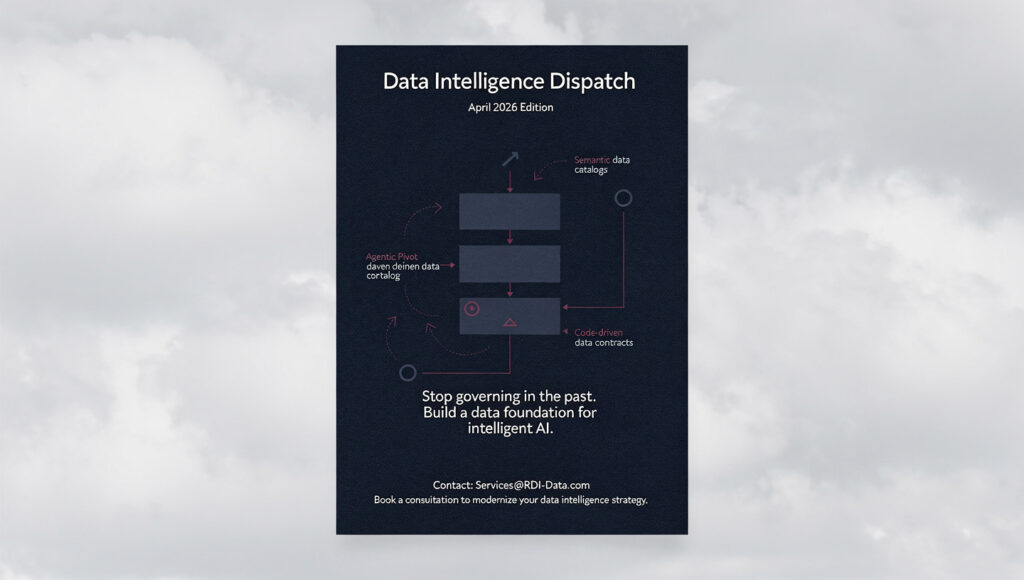
Stop governing in the past. Build a foundation that matches the speed of the Agentic Pivot.
Contact Services@RDI-Data.com or book a consultation here to modernize your data intelligence strategy.

1. Google Cloud and Collibra Deepen Partnership to Bring Business Context and Semantics Directly to Knowledge Catalog
Business Driver: Accelerating cloud analytics and AI deployment safely by eliminating the manual, fragmented process of mapping physical cloud assets to actual business meaning.
Key Takeaway: Enterprise-grade semantics must live where work happens. Unifying Collibra’s deep business context with Google Cloud’s native environments gives non-technical business teams immediate, self-service trust in their data pipelines.
Summary: Announced on April 22, 2026, this expanded strategic partnership introduces a bi-directional integration designed to break down metadata silos. By natively embedding Collibra’s enterprise business glossaries and data quality indicators directly into Google Cloud’s ecosystem, organizations can automatically enrich their cloud architectures with the precise business context required to scale trusted AI use cases.
2. New Collibra Survey by The Harris Poll Finds 84% of Decision Makers Say AI Spending Must Increase, While Many Say It’s Under-Delivering
Business Driver: Maximizing return on investment (ROI) for escalating AI budgets while actively mitigating the corporate risk of ungoverned autonomous systems.
Key Takeaway: More compute won’t fix poor data execution. To bridge the AI execution gap, 90% of tech leaders agree that organizations must establish clear governance frameworks, including mandating public disclosures when autonomous AI agents interact with data.
Summary: Published in early April 2026, this landmark survey highlights a critical executive paradox: an urgent competitive pressure to dump capital into AI, paired with widespread frustration that current deployments are falling short. The report serves as a wake-up call for CIOs to pivot away from ad-hoc model testing and establish formalized, unified data and AI governance guardrails.
3. Alation Appoints Rick Baker as Chief Operating Officer to Scale Outcome-Based Governance
Business Driver: Overcoming the human bottleneck of traditional data stewardship, where manual logging simply cannot keep pace with modern data volumes.
Key Takeaway: Data governance must shift from a “process-driven” bureaucracy to an “intent-driven” operating model, using autonomous metadata curation agents to automatically interpret and enforce organizational standards.
Summary: On April 7, 2026, Alation announced the expansion of its global executive leadership alongside updates to its Curation Automation tool. By deploying an agent-powered architecture into the data catalog layer, the platform allows businesses to declare a desired outcome—such as regulatory compliance or AI readiness—and lets continuous automation handle metadata enrichment at scale.
Link: Alation Appoints Rick Baker as Chief Operating Officer
4. Data Lineage for Large Language Model (LLM) Training Market Report 2026
Business Driver: Ensuring strict legal compliance, data sovereignty, and audit-ready explainability for corporate AI models as global transparency regulations tighten.
Key Takeaway: Track the provenance or face the liability. The explosive growth of the LLM training lineage market proves that documenting exactly which records, files, and transformations fed an algorithm is the new baseline for responsible enterprise AI.
Summary: This comprehensive global market study released on April 20, 2026, tracks the soaring demand for AI data provenance, projecting the niche market to hit $5.07 billion by 2030. Driven by the critical need to detect bias, prevent data drift, and ensure copyright transparency, automated lineage is rapidly moving from an obscure technical map to a mandatory C-suite control.
5. Data Lineage: The Foundation of Enterprise Data Infrastructure (2026 Guide)
Business Driver: Minimizing downstream “blast radius” failures and drastically reducing engineering cycles spent on manual troubleshooting.
Key Takeaway: Data lineage is the operational spine of the entire modern data stack. Upgrading to column-level tracking shrinks traditional root-cause analysis timelines from 3-4 weeks down to mere hours.
Summary: Published on April 21, 2026, this strategic playbook reframes data lineage from a passive compliance checkbox to a live infrastructure utility. By automatically parsing SQL logs and orchestration layers, lineage propagates trust signals across the enterprise, alerting engineers which BI dashboards or AI feature stores will break before a schema change is deployed.
Link: Data Lineage: The Foundation of Enterprise Data Infrastructure (2026 Guide) – Decube
6. What’s New in Informatica Data Integration: April 2026 Cloud Release
Business Driver: Accelerating data engineering velocity by automating pipeline creation and eliminating the chronic backlog of technical data requests.
Key Takeaway: AI-native metadata generation is putting complex integration capabilities directly into the hands of data stewards, bypassing the need for manual, slow-coded development.
Summary: Informatica’s mid-April 2026 documentation features massive updates to its Intelligent Data Management Cloud (IDMC), spearheaded by the CLAIRE® Copilot. The release enables technical teams to leverage natural language to automatically generate transformations, build expression logic, and map local field metadata instantly, drastically speeding up catalog ingestion.
Link: What’s New in Data Integration – April 2026 – Informatica Support
7. Liquibase Adds Change Intelligence to Make Database Delivery Safer and More Observable
Business Driver: Protecting critical transactional databases from accidental corruption and downstream analytics breakage caused by uncoordinated database structural changes.
Key Takeaway: True data intelligence requires extending metadata tracking down to the CI/CD database deployment layer, making schema evolution visible before it fractures business reporting.
Summary: Featured in Solution Review’s early-April roundup, Liquibase introduced its new Change Intelligence capabilities. By automatically analyzing and logging database changes ahead of deployment, this feature bridges the gap between active database development and the data catalog, feeding automated lineage tools with real-time updates.
Link: Data Management News for the Week of April 3; Updates from Collibra, Liquibase, Oracle & More
8. Whats New with Data and AI Governance: Building the Catalog for AI at Google Cloud Next 2026
Business Driver: Grounding corporate generative AI apps in verified, secure corporate parameters to eliminate the business liability of algorithmic hallucinations.
Key Takeaway: The traditional data catalog must evolve into a “Map for AI,” shifting away from static, highly technical table lists toward a fluid, machine-readable semantic layer.
Summary: This engineering-led deep dive presented live on April 22, 2026, at Google Cloud Next explored the cutting edge of catalog design. The session detailed how automated metadata enrichment can map complex data estates with semantic context, turning a passive asset inventory into a reliable blueprint that autonomous AI agents can interpret and act upon.
Link: What’s New with Data and AI Governance: Building the Catalog for AI – Session Details
9. What’s New in the Collibra Platform: Spring 2026 Release Rollout
Business Driver: Scaling decentralized data product development across complex, multi-cloud structures without losing centralized access control or crushing processing performance.
Key Takeaway: Establishing clear Data Contracts ensures strict, cross-functional data product consistency, while federated query support provides the compute flexibility required to audit data quality on the Edge.
Summary: Collibra’s April 2026 platform rollouts highlight features designed to support modern, distributed architectures. Key innovations include automated workflows for managing Data Contracts to keep teams aligned, a centralized Unified AI Registry, and new “Pullup support,” which allows data quality jobs to run locally in a Spark engine on Edge nodes, conserving expensive centralized cloud warehouse processing resources.
Link: What’s New in the Collibra Platform | Spring 2026 Product Innovations
10. Best Data Lineage Tools Compared 2026: Activating Automated Curation
Business Driver: Navigating the massive complexity of the modern multi-cloud data fabric, which has created a multi-billion-dollar market for automated trust solutions.
Key Takeaway: The global data lineage market has hit $2.1 billion, growing at a 22.2% CAGR, underscoring that automated column-level parsing is now an industry baseline for scaling analytics safely.
Summary: This end-of-April 2026 comparative analysis highlights how leading governance platforms have adapted to complex ETL, dbt, and Snowflake ecosystems. The report warns that fewer than 30% of enterprises have completely automated their lineage tracking, separating market leaders—who can conduct an immediate blast-radius impact analysis—from organizations bogged down by manual documentation debt.