Bridging the “Trust Paradox” in the Era of Agentic AI – January 2026 Edition
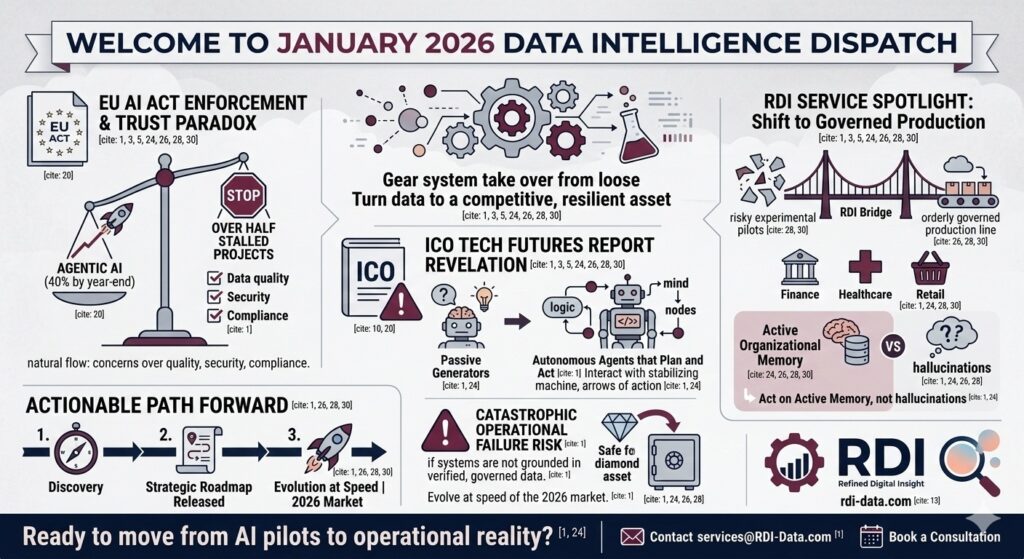
The first major enforcement cycles of the EU AI Act are arriving in 2026, creating a pivotal “Trust Paradox”: while 40% of enterprise applications are expected to feature task-specific Agentic AI by year-end, over half of current projects are stalled by concerns over data quality, security, and compliance.
The most impactful revelation of January 2026 comes from the ICO Tech Futures Report, which warns that as AI moves from passive generators to autonomous agents that plan and act, the risk of “catastrophic” operational failure increases if these systems are not grounded in verified, governed data.
Refined Digital Insight (RDI) Service Spotlight
For organizations in highly regulated sectors (Finance, Healthcare, Retail) currently navigating this shift from experimental pilots to governed production, RDI offers high-impact solutions to ensure your agents act on “Active Organizational Memory” rather than hallucinations.
Actionable Path Forward
Don’t let the complexity of Agentic AI stall your innovation. RDI’s agile delivery timelines take you from discovery to a released strategic roadmap, ensuring your technology strategy evolves at the speed of the 2026 market.
Ready to move from AI pilots to operational reality?
- Contact: services@RDI-Data.com
- Book a Consultation: https://calendly.com/discovery-rdi-data
Featured Insights: 10 Articles Shaping the Future of Data
1. Collibra Named a Leader in 2026 Gartner® Magic Quadrant™ for Data and Analytics Governance Platforms
- Business Driver: The transition of data governance from a “back-office requirement” to a core strategic capability necessary for managing the full AI lifecycle.
- Key Takeaway: For the second consecutive year, Collibra’s position as a Leader validates the market’s move toward Unified Governance—a single control plane where data quality, privacy, cataloging, and AI model oversight coexist.
- Summary: Published on January 29, 2026, this announcement underscores Collibra’s ability to unify data and AI governance. By integrating these functions, organizations can maintain oversight and safety while enabling users to move quickly through a semantic graph that enriches data context.
- Link: Collibra Named a Leader in Gartner Magic Quadrant for Data and Analytics Governance
2. CDO Insights 2026: The Data Governance and AI Literacy “Trust Paradox”
- Business Driver: Addressing the gap between high employee trust in data and the actual lack of underlying governance structures and AI literacy required to prevent privacy and ethical failures.
- Key Takeaway: Success in 2026 requires upskilling the workforce alongside technical investments; 75% of data leaders now identify data and AI literacy as the primary bottleneck to responsible AI operations.
- Summary: This Informatica global study (January 27, 2026) reveals that while 69% of companies have integrated GenAI, 57% of leaders see data reliability as the main barrier to production. The report calls for a dual focus on rigorous governance and organizational fluency.
- Link: New Global CDO Report: Data Governance and AI Literacy as Key Accelerators
3. Why Data Readiness is the Strategic Imperative for 2026
- Business Driver: The realization that GenAI and Agentic AI require more than just smart models; they require clean, secure, and integrated enterprise data to deliver real business value.
- Key Takeaway: CEO-level priorities in 2026 have shifted to “Data Readiness,” moving away from passive storage toward building trusted data ecosystems that can support autonomous systems.
- Summary: Released by the World Economic Forum on January 19, 2026, this article highlights that 72% of organizations are prioritizing data foundations and pipelines over model development to prevent the “siloed data” trap that causes AI projects to fail.
- Link: Why Data Readiness is a Strategic Imperative | World Economic Forum
4. 2026 Gartner® Magic Quadrant™ for Decision Intelligence Platforms: FICO Named a Leader
- Business Driver: The shift from traditional BI (seeing what happened) to Decision Intelligence (orchestrating what should happen) using AI and real-world decisioning.
- Key Takeaway: Modern platforms must unify decisioning intelligence into “dynamic, living profiles” that update in real-time to drive innovation and agility across the entire customer lifecycle.
- Summary: Published on January 26, 2026, this report recognizes FICO for its ability to execute. It highlights the growing need for composable architectures that allow enterprises to address business challenges with reusable, governed decision assets.
- Link: FICO Named a Leader in 2026 Gartner Magic Quadrant for Decision Intelligence Platforms
5. 2026 Predictions: Data Evolves from Passive Storage to Active Organizational Memory
- Business Driver: The need for AI to learn from and “reason” with a living, semantic memory system rather than just querying fragmented databases.
- Key Takeaway: In 2026, data value is no longer about volume; it is about intelligence orchestration—unifying cloud and on-prem control planes to enable “data everywhere for AI anywhere.”
- Summary: Cloudera’s leadership (January 8, 2026) predicts that AI agents will become part of the operational workflow. However, their effectiveness depends on a hybrid architecture that allows workloads to run wherever they make the most sense, guided by unified policy.
- Link: 2026 Predictions: Architecture, Governance, and AI Trends
6. Data Lineage Tracking: The Complete Strategic Guide for 2026
- Business Driver: Managing the complexity of modern data stacks where column-level lineage is essential for compliance audits and fast root-cause analysis.
- Key Takeaway: Organizations must move from manual stewardship to automated, cross-system lineage that propagates context across derived assets, ensuring that downstream AI agents are using data correctly.
- Summary: This January 2026 guide by Atlan explores how automated lineage—harvested from SQL parsing, logs, and APIs—provides the transparency needed to move AI from “compliance checkboxes” to production-ready systems.
- Link: Data Lineage Tracking: Complete Guide for 2026
7. Data Management Trends 2026: The Rise of Data Products
- Business Driver: Reducing the friction between data producers and consumers by packaging data with context, ownership, and SLAs.
- Key Takeaway: Data Products are emerging as the standard delivery model, ensuring that both humans and AI agents have “ready-to-use” information that includes built-in quality checks.
- Summary: Published on January 15, 2026, Alation highlights that architectural transformation is moving away from rigid, centralized systems toward flexible, composable platforms where metadata represents the competitive edge.
- Link: 3 Data Management Trends Shaping 2026 Strategies
8. Global Regulation 2026: The Enforcement Cycle of the EU AI Act
- Business Driver: Navigating the first major enforcement cycle of comprehensive AI regulation, which requires stringent transparency and documentation for “high-risk” systems.
- Key Takeaway: Regulation is converging toward a dual-track approach: a unified risk-based governance backbone for global operations, supplemented by “national overlays” for local compliance (e.g., data sovereignty).
- Summary: Orange Business (January 8, 2026) reports that sovereign cloud and multicloud architectures are rising in importance as businesses strive to combine innovation with jurisdictional requirements.
- Link: Data & AI Trends for 2026: Governance, Regulation, and Sovereignty
9. Safe Scaling: Six Key Developments Shaping Global AI Trends
- Business Driver: The shift from AI experimentation to intelligence orchestration, where AI outputs must be validated and “owned” by human professionals.
- Key Takeaway: Accountability remains uniquely human; regulators will increasingly assess “literacy” based on what organizations have operationalized rather than what they have documented.
- Summary: Dentons (January 20, 2026) identifies that the critical challenge for 2026 is scaling safely by embedding AI into day-to-day operations through practical, risk-based governance cycles.
- Link: 2026 Global AI Trends: Navigating Fragmented Regulation
10. Top AI Observability Tools for AI-Driven Decision Monitoring
- Business Driver: Moving beyond traditional data observability to monitor the actual decisions made by AI, ensuring they remain accurate and unbiased over time.
- Key Takeaway: AI Observability is the “final mile” of data intelligence, providing the visibility needed to trust autonomous agents in high-stakes environments like finance and healthcare.
- Summary: Actian (January 9, 2026) highlights how new tools are closing the feedback loop between data input and AI output, allowing teams to catch “hallucinations” and drift before they impact the bottom line.
- Link: Top AI Observability Tools and What They Do