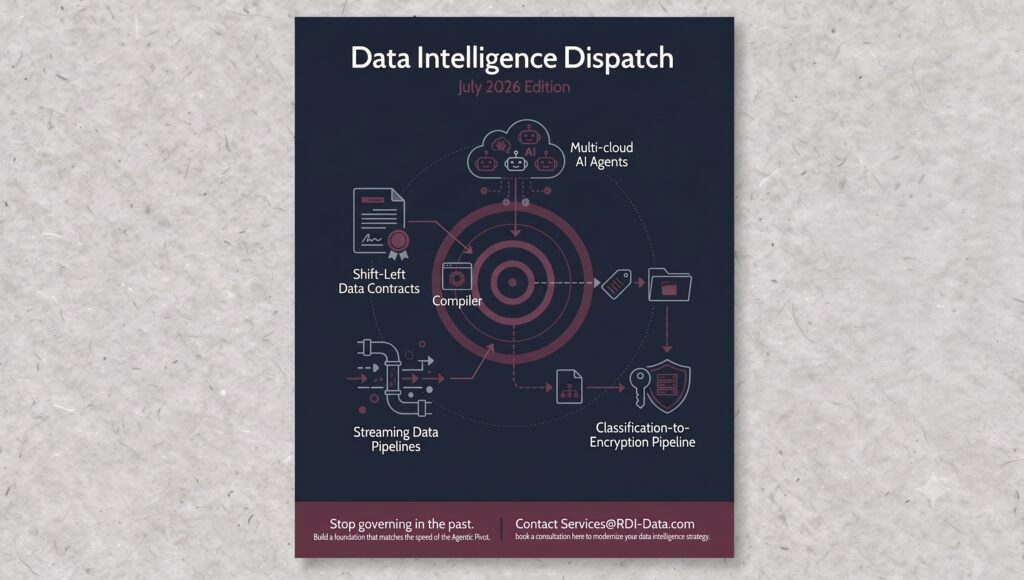
Welcome to the July 2026 edition of the Data Intelligence Dispatch. This past month marked a major inflection point in enterprise data strategy: organizations are moving beyond basic model experimentation and confronting the operational reality of managing autonomous AI agents at scale.
The defining theme of July 2026 is contextual enforcement and data-centric protection. Modern enterprises are realizing that traditional perimeter-based governance and static metadata catalogs cannot keep up with multi-cloud AI agents, streaming pipelines, and unmapped unstructured files. By embedding governed context compilers, automated file classification-to-encryption pipelines, and shift-left data contracts directly into execution engines, leaders are turning data lineage and catalogs into live operational control planes.
The Breakthrough: Real-Time Contextual Enforcement for Autonomous AI
As autonomous AI agents move from isolated pilots into production environments, traditional perimeter defense and static data catalogs are no longer sufficient. July 2026 has demonstrated that when multi-cloud AI agents interact with streaming pipelines and unstructured document estates, governance must evolve from reactive documentation into live, data-centric enforcement.
Why this matters: An autonomous AI agent lacks human intuition to spot unverified or sensitive context. If raw, unmapped data feeds into an agentic workflow, it introduces severe compliance risks and model hallucinations. Embedding context compilers and automated classification-to-encryption pipelines directly into execution engines ensures that security rules, access boundaries, and data contracts are enforced programmatically at the millisecond of execution.
Organizations adopting shift-left data contracts and active context compilers are eliminating hallucination risks, preventing multi-cloud data leaks, and establishing transparent, auditable control across all automated execution layers. This operational shift directly addresses Chief Information Security Officers (CISOs), Chief Risk & Compliance Officers (CROs), and Data Security & AI Sponsors. These leaders face immense pressure to enable high-impact, autonomous AI capabilities across multi-cloud environments, but they cannot risk exposing proprietary assets, violating privacy mandates, or incurring regulatory penalties.
Refined Digital Insight (RDI) delivers the strategic frameworks, engineering backbones, and governance infrastructure required to turn static catalogs into active operational control planes.
1. AI Readiness Plan & Enablement Service
To ensure multi-cloud AI agents run within secure, compliant execution boundaries, RDI establishes a comprehensive AI governance foundation:
- Strategic Alignment: We collaborate directly with your business leadership and AI use case sponsors to unify business objectives, security requirements, and risk thresholds in writing.
- AI Ecosystem Maturity Assessment: Our experts evaluate your data and technology landscape against RDI’s proprietary AI Reference Architecture model to identify safety gaps and infrastructure priorities.
- Actionable Framework Creation: We deliver a complete AI Readiness Framework to guide safe implementation, model risk management, and ongoing governance.
2. Custom DevOps Integration Service
To implement shift-left data contracts and automated classification-to-encryption pipelines, RDI builds mature, security-first data engineering practices:
- Process & Data Flow Assessment: We perform thorough walkthroughs across business, data, and IT teams to map data flows, streaming pipelines, and integration points.
- Security & Compliance Mapping: RDI designs custom DevOps blueprints that incorporate security-by-design principles, regulatory compliance mapping, and integrated reporting.
- Zero-Downtime Deployment & Continuous Monitoring: We deploy Infrastructure-as-Code (IaC) solutions with real-time performance monitoring, security tracking, and automated compliance reporting.
3. Data Intelligence Startup & Healthcheck Services
For organizations needing to establish or validate their baseline governance model before scaling autonomous agents, RDI provides structured oversight:
- Data Management Assessment: We evaluate your current data systems, metadata practices, and governance protocols to deliver a detailed value assessment report.
- Data Governance Framework: RDI develops and helps deploy a tailored governance framework designed for modern, machine-speed environments.
- Ongoing Plan Adherence: We perform scheduled quarterly health checks to monitor plan adherence, update policies, and maintain alignment with evolving technologies.
Secure Your AI Control Plane Today
Don’t let ungoverned AI agents or unmapped multi-cloud data compromise your enterprise innovation. Turn data lineage and governance into a live, automated defense engine.
Contact Services@RDI-Data.com or book a consultation directly with our discovery team.

1. A Single Governed Source of Truth for Every AI Agent: Introducing Collibra’s Governed Context Compiler
- Business Driver: Resolving contextual drift and preventing hallucinations when autonomous AI agents execute queries across multi-cloud systems like Snowflake, Databricks, and AWS.
- Key Takeaway: AI agents fail when they don’t understand your business rules. The Governed Context Compiler continuously translates enterprise glossaries, privacy constraints, and data lineage into machine-readable context served directly to AI agents at execution runtime.
- Summary: Published on July 28, 2026, Collibra announced its Governed Context Compiler. This platform module acts as an operational bridge between centralized data governance and distributed AI models. By compiling business definitions, access permissions, and column-level lineage graphs into an active semantic layer, the compiler ensures AI agents interpret metrics correctly (e.g., distinguishing gross revenue from billing totals) and stay within legal boundaries.
- Link: A Single Governed Source of Truth for Every AI Agent and Platform: Introducing Collibra’s Governed Context Compiler
2. Virtru and Ohalo Partner to Deliver AI-Driven Data Discovery, Classification, and Governance for Sensitive Unstructured Data
- Business Driver: Eliminating the high-risk security gap between discovering sensitive unstructured files (contracts, emails, research) and persistently protecting them across hybrid cloud environments.
- Key Takeaway: Static data discovery without automated remediation leaves enterprises vulnerable. Connecting Ohalo’s deep file-level classification engine directly to persistent encryption transforms static metadata inventories into real-time data protection.
- Summary: Announced on July 14, 2026, Virtru and Ohalo launched an integrated solution that automates the pipeline from unstructured file discovery to policy-driven encryption. Ohalo’s Data X-Ray scans documents at hundreds of thousands of words per second using NLP, GenAI, and business rules to classify file content. That enriched metadata immediately triggers Virtru’s data-centric encryption, ensuring sensitive files stay protected regardless of where they travel.
- Link: Virtru and Ohalo Partner to Deliver AI-Driven Data Discovery, Classification, and Governance for Sensitive Unstructured Data
3. Alation Recognized as a 2026 Gartner® Peer Insights™ Customers’ Choice in Metadata Management and Governance Solutions
- Business Driver: Selecting peer-validated data intelligence platforms to anchor enterprise AI scaling on trusted, audit-ready data foundations.
- Key Takeaway: Enterprise buyers prioritize unified platforms. Connecting metadata, AI agents, business context, and data governance in a single “Intelligence Operating System” (AIOS™) is essential for converting AI investment into measurable ROI.
- Summary: On July 21, 2026, Alation announced its dual recognition as a Customers’ Choice in two Gartner Peer Insights reports (Metadata Management Solutions and Data & Analytics Governance Platforms). Driven by verified customer reviews, the distinction highlights how organizations use Alation’s AIOS architecture to unify data discovery, automate metadata enrichment, and govern autonomous AI workflows without manual gatekeeping.
- Link: Alation Named a 2026 Gartner® Peer Insights™ Customers’ Choice
4. BigID Named a Strong Performer in 2026 Gartner Peer Insights™ for Data Security Posture Management (DSPM)
- Business Driver: Gaining continuous visibility over where sensitive data lives and who can reach it as a mandatory prerequisite for deploying autonomous AI agents safely.
- Key Takeaway: DSPM is the foundational data layer of the “Agentic Control Plane,” enabling security teams to enforce precise access guardrails over LLM applications and non-human identities.
- Summary: Published on July 13, 2026, BigID detailed its recognition in the Gartner Peer Insights DSPM report. The release emphasizes that discovering sensitive data and mapping identity permissions is no longer just for compliance—it forms the underlying control engine (AskBigID™ and Agentic Access Governance) needed to prevent AI copilots from leaking confidential internal records.
- Link: BigID Named a Strong Performer in the 2026 Gartner Peer Insights™ “Voice of the Customer” for DSPM
5. Microsoft Fabric July 2026 Feature Summary: Recommended Actions in OneLake Catalog Govern Tab
- Business Driver: Eliminating manual investigation loops for data stewards by delivering guided, single-click governance remediation across enterprise lakehouses.
- Key Takeaway: Passive governance recommendations stall; modern data catalogs must pair health metrics with dedicated, step-by-step resolution workflows to keep data estates secure and organized.
- Summary: Released on July 29, 2026, Microsoft’s monthly Fabric update overhauled the OneLake catalog Govern tab. Rather than simply alerting data owners to unlabelled security risks or stale datasets, the new experience surfaces exact entity breakdowns, explains the governance impact, and offers direct action buttons to apply sensitivity labels or archive unused assets immediately.
- Link: Fabric July 2026 Feature Summary: OneLake Catalog Govern Tab Enhancements
6. Managing the “Agent Sprawl” Risk: European Data & AI Infrastructure Review
- Business Driver: Controlling runaway operational costs, security blind spots, and regulatory exposure caused by unmonitored enterprise AI agent deployment.
- Key Takeaway: Scaling agentic AI requires shifting focus from underlying model capabilities to unified data governance platforms capable of managing agent identities, data permissions, and audit trails.
- Summary: Published on July 24, 2026, this enterprise AI review warns against “agent sprawl”—a state where organizations lose visibility over the number, data access rights, and inference costs of autonomous agents. The report emphasizes that establishing disciplined governance over agent activity and data architecture is the defining factor separating successful AI deployments from costly operational failures.
- Link: Data & AI Monthly Press Review – July 2026: Preparing IT for Agentic AI
7. Shift-Left Data Governance & Policy-as-Code: Insights from Data Architecture Online 2026
- Business Driver: Preventing data governance requirements from delaying software delivery while ensuring pipeline metadata remains resilient under AI workloads.
- Key Takeaway: Embedding governance controls directly into CI/CD pipelines via Policy-as-Code enforces compliance automatically before code deployments hit production databases.
- Summary: Following the Data Architecture Online conference on July 22, 2026, DATAVERSITY highlighted key architectural patterns presented by leaders from PayPal, Meta, and IBM. The sessions focused on “Shift-Left Governance”—the practice of defining data contracts, lineage definitions, and access policies in code, allowing automated checks to validate data quality and metadata ownership during development build cycles.
- Link: Data Architecture Online 2026: Building AI-Resilient Architectures
8. The Data Lineage Process: From First Critical Data Element (CDE) to Operational Governance
- Business Driver: Ensuring data lineage implementations transition from static graph diagrams into active, operational governance assets used during regulatory audits.
- Key Takeaway: Lineage capture without an operational governance framework quickly becomes stale; long-term adoption requires linking technical lineage graphs directly to business glossaries and CDE definitions.
- Summary: Published on July 29, 2026, this strategic guide outlines a six-phase methodology for executing enterprise data lineage. It addresses the common trap of declaring victory when automated technical scanners finish mapping SQL scripts. The guide details how to build business stakeholder trust by linking critical data elements to lineage maps, ensuring readiness for DORA, BCBS 239, and EU AI Act compliance checks.
- Link: The Data Lineage Process: From First CDE to Operational Governance
9. AI Data Lineage: Shifting Provenance Left with Data Contracts as Code
- Business Driver: Eliminating silent model degradation caused when upstream software developers modify database schemas or rename feature fields without warning.
- Key Takeaway: Tracing data lineage downstream after a model breaks is too late; defining data provenance upstream via “Data Contracts as Code” prevents corrupted data from entering feature stores.
- Summary: Published on July 1, 2026, Gable’s engineering guide addresses why traditional lineage methods break down in machine learning pipelines. The article highlights how upstream schema changes silently corrupt recommendation and scoring models. By treating data lineage as a declarative upstream contract, data teams can catch schema breaking changes in pull requests before bad inputs pollute downstream AI feature stores.
- Link: AI Data Lineage: A Complete Guide for Data Teams
10. Public Review Opens for Canada’s Draft National Standard on Data-Centric Security
- Business Driver: Adapting enterprise data architectures to meet upcoming national regulatory standards that mandate persistent security attached directly to data assets.
- Key Takeaway: Data security governance is shifting from perimeter infrastructure defenses to data-centric controls that enforce protection across streaming data pipelines and AI database stores.
- Summary: On July 14, 2026, the Digital Governance Standards Institute opened public review for the second edition of Canada’s National Standard on Data-Centric Security. The updated draft expands compliance requirements beyond traditional file stores to cover real-time streaming data and AI databases. It establishes that metadata tagging, encryption, and sovereignty tracking must remain natively bound to data objects regardless of where they are processed.
- Link: Public Review Opens for Canada’s Next National Standard for Data-Centric Security