The Breakthrough: Runtime Compliance & Machine-Speed Active Context
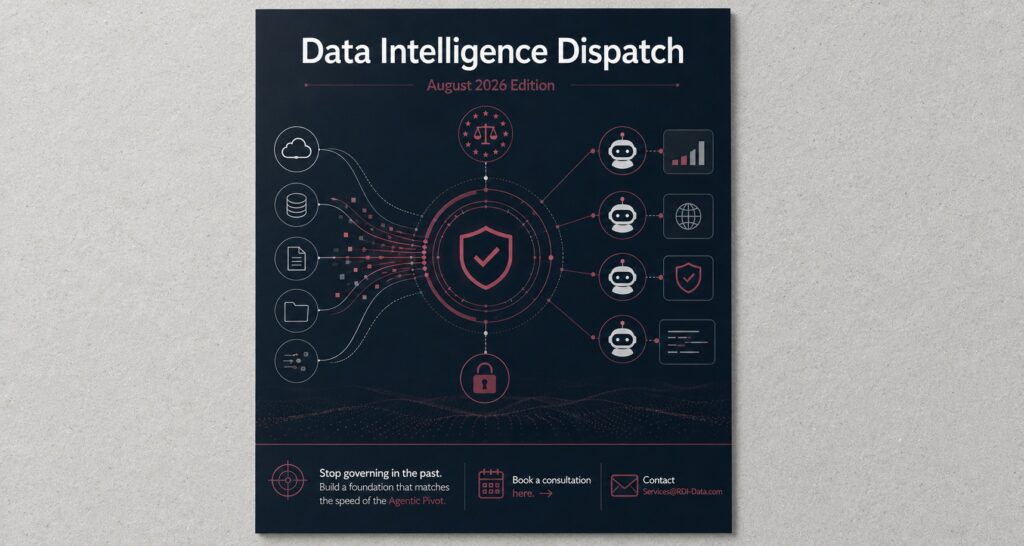
The full legal enforcement of high-risk AI rules under the EU AI Act marks the end of reactive, manual governance. Regulatory mandates now demand continuous data management, verifiable lineage, and strict auditability for models deployed in high-impact environments. Simultaneously, the rapid standardization of the Model Context Protocol (MCP) has provided the architecture required to stream governed context straight to AI agents in real time.
The Operational Reality of August 2026: Human-speed approval workflows cannot keep pace with autonomous agent execution. When AI systems dynamically query datasets across cloud boundaries, compliance cannot be proven through periodic manual audits. Data contracts, column lineage, and object-level encryption must be programmatically enforced at the exact millisecond of tool execution.
Organizations implementing active context control planes are bridging the gap between legal policy and engineering runtime—mitigating regulatory exposure under global frameworks while ensuring autonomous agents act only on trusted context.
Operationalize Machine-Speed AI Governance with RDI
Refined Digital Insight (RDI) delivers the strategic frameworks, custom DevOps integrations, and active metadata solutions required to turn static documentation into automated compliance control planes[cite: 5, 7, 9].
1. AI Readiness Plan & Enablement Service
To ensure your AI architecture complies with new regulatory standards and operates within safe execution boundaries, RDI provides a structured enablement blueprint:
Strategic & Regulatory Alignment: We collaborate directly with your business leadership and AI sponsors to unify business goals, risk boundaries, and compliance targets in writing.
AI Ecosystem Maturity Assessment: Our experts evaluate your technology landscape against RDI’s proprietary AI Reference Architecture model to identify critical compliance and data gaps.
Actionable Framework Creation: We deliver a comprehensive AI Readiness Framework to guide sustainable AI implementation, priority use cases, and model governance.
2. Custom DevOps Integration Service
To build the runtime infrastructure required for Model Context Protocol integration, automated lineage, and real-time encryption, RDI engineers custom data backbones:
Process & Data Flow Assessment: We conduct thorough walkthroughs across business, data, and IT teams to evaluate pipeline efficiency and context boundaries.
Security & Compliance Mapping: RDI designs custom DevOps blueprints featuring security-by-design principles, regulatory compliance mapping, and integrated reporting.
IaC Deployment & Real-Time Monitoring: We deploy Infrastructure-as-Code (IaC) solutions with zero downtime launch and real-time performance, security, and compliance tracking.
3. Collibra Managed Services: Active Metadata Enablement
For enterprises seeking to feed active metadata directly into agentic runtimes, RDI converts passive catalogs into dynamic governance engines:
Metadata Enablement (Tier 2): We automate discovery and manage up to 30 metadata loads per quarter via RDI connectors to keep context fresh for runtime reasoning.
Tailored Value Services (Tier 3): RDI delivers targeted quarterly deliverables—including advanced integrations, custom reporting, and policy automation—aligned to your AI initiatives and budget cycles.
Secure Your Compliant AI Control Plane Today
 Don’t let regulatory enforcement or legacy governance frameworks halt your enterprise AI deployment. Partner with RDI to build automated, audit-ready context control planes operating at machine speed.
To get started, contact Services@RDI-Data.com or book a consultation directly with our discovery team
1. Governed AI at the Speed of Snowflake: How Collibra MCP Powers Snowflake CoWork & Cortex
Business Driver: Accelerating generative AI application development while eliminating data leakages and metric inconsistencies across multi-cloud environments.
Key Takeaway: Delivering governed context via the Model Context Protocol (MCP) allows enterprises to dynamically inject verified business glossaries, quality metrics, and lineage rules directly into AI model runtimes without writing custom integration code per prompt.
Summary: Published on August 26, 2026, Collibra announced its native integration supporting the open Model Context Protocol (MCP). This milestone enables Collibra’s enterprise Knowledge Graph to stream certified business definitions, data quality scores, and column-level lineage directly into Snowflake Cortex and CoWork runtimes. By serving as a single, live source of truth at execution time, the integration prevents AI hallucination and ensures automated agents strictly adhere to corporate data policies.
Link: Governed AI at the speed of Snowflake: How Collibra MCP powers Snowflake CoWork & Cortex
2. Automating File Remediation at Scale: Virtru and Ohalo Partner to Bridge Discovery and Protection
Business Driver: Eliminating severe legal exposure in unstructured file repositories (contracts, PDFs, legacy shared drives) where up to 80% of an organization’s sensitive data remains unclassified and exposed.
Key Takeaway: Static data discovery alone leaves companies vulnerable; true unstructured governance requires coupling ML file classification with continuous, object-level zero-trust encryption that travels with the file wherever it resides.
Summary: As EU AI Act enforcement hit in August 2026, Ohalo’s deep integration with Virtru provided a critical blueprint for unstructured data security. By leveraging Ohalo Data X-Ray to scan and classify unstructured files at 100,000 words per second, the joint solution automatically triggers persistent Zero Trust Data Format (ZTDF) encryption based on policy attributes. This enables enterprises to remediate petabytes of “dark data” across cloud and on-premise repositories in a single automated workflow.
3. Alation & PwC Canada Forge Partnership to Operationalize AIOS for Regulated Industries
Business Driver: Complying with stringent financial regulations (such as OSFI Guideline E-21, DORA, and BCBS 239) by converting compliance from a manual, point-in-time audit into a continuous software capability.
Key Takeaway: Pre-built, self-improving industry accelerators leverage AI agents to automate Critical Data Element (CDE) classification and lineage tracing, delivering auditor-ready evidence packages in days.
Summary: Published on August 14, 2026, Alation and PwC Canada announced a strategic partnership pairing Alation’s AIOS (AI Intelligence Operating System) with PwC’s regulatory expertise. The joint accelerators allow highly regulated financial institutions to automatically map data risk, track lineage across complex data pipelines, and maintain continuous, self-healing compliance documentation without manual stewardship overhead.
Link: Alation & PwC Canada Forge Data Governance Partnership for Regulated Industries
4. Compressing AI Agent Timelines from Months to Weeks with Context Platforms
Business Driver: Overcoming the 6-to-12-month development bottleneck of enterprise AI projects by replacing manual prompt engineering with centralized metadata context repositories.
Key Takeaway: AI Context Platforms dramatically shorten time-to-value by managing enterprise glossaries, schemas, and lineage as versioned, reusable code assets served directly to model runtimes.
Summary: Released on August 25, 2026, Atlan’s analysis of the August 7 Gartner Emerging Tech Impact Radar details how managing context as infrastructure compresses AI agent deployment timelines. By establishing a managed context layer over open protocols like MCP, organizations eliminate custom prompt writing and ensure new AI agents immediately understand corporate data definitions and access boundaries.
Link: AI Context Platform Implementation Time: Months to Weeks
5. EU AI Act High-Risk Enforcement Begins: Article 10 Mandates Governed Data Lineage and Provenance
Business Driver: Mitigating severe regulatory penalties (up to €35 million or 7% of global turnover) as full enforcement of high-risk AI system obligations takes effect.
Key Takeaway: Article 10 compliance is fundamentally a context infrastructure problem; high-risk AI deployers must maintain documented data lineage proving training set relevance, representativeness, and error-free quality.
Summary: With the EU AI Act’s high-risk AI provisions applying as of August 2, 2026, legal and engineering teams are focused on operationalizing compliance. Analysis published throughout August details how Article 10 mandates that training, validation, and testing datasets be governed under strict metadata practices. Automated data lineage tools are essential to provide auditors with explicit records of data collection processes, origin, and transformation history.
Link: EU AI Act Compliance: Everything You Need Before August 2026
6. Data Lineage Tooling in 2026: Shift-Left Impact Analysis and Operationalized Trust Signals
Business Driver: Preventing costly executive dashboard outages and AI model failures caused by unannounced schema or business logic changes in complex cloud pipelines.
Key Takeaway: Modern data lineage must move beyond technical consoles and expose active trust signals (quality status, sensitivity, ownership) directly inside data marketplaces and developer workflows.
Summary: Published on August 27, 2026, Amurta’s editorial framework details how enterprise data lineage has evolved into a proactive operational utility. The guide outlines how engineering teams utilize automated column-level lineage to conduct pre-release impact analysis before executing schema changes. Furthermore, connecting lineage directly to master data management (MDM) hubs ensures compliance teams maintain auditable proof of regulated data movement.
7. Supply Chain Analytics: Eliminating the “Meaning Shortage” Through Governed Data Products
Business Driver: Resolving definitional conflicts across ERP, WMS, and supplier portals that cause cross-functional teams to report conflicting operational metrics.
Key Takeaway: Deploying AI on undocumented data creates expensive failure patterns where agents act on flawed definitions; establishing governed data products with explicit lineage ensures metric consistency.
Summary: Published on August 20, 2026, Alation’s supply chain analysis highlights a growing industry gap: while 67% of supply chain digital budgets go toward AI, over 55% of leaders struggle to demonstrate clear ROI due to semantic drift and ungoverned data. The article emphasizes that building governed data products—supported by an active data catalog—is the only way to ensure AI agents act on reconciled, trusted business metrics.
Link: Supply Chain Analytics: Turning Fragmented Data Into Real-Time Visibility
8. Extending Data Governance to the Perimeter: Collibra Edge and Distributed Metadata Intelligence
Business Driver: Enforcing data privacy and cross-border data residency rules across distributed on-premise and private cloud systems without incurring massive cloud data egress costs.
Key Takeaway: Running localized metadata processing close to the data source allows enterprises to share metadata centrally while ensuring raw sensitive data never crosses physical or legal boundaries.
Summary: Updated on August 18, 2026, this technical architecture analysis details how global enterprises deploy lightweight execution engines like Collibra Edge. By conducting automated sensitive data discovery, lineage mapping, and quality profiling locally within regional firewalls, organizations maintain central catalog visibility while fully complying with strict data sovereignty mandates.
9. Enterprise Data Governance Evaluation 2026: Transitioning from Passive Dictionaries to Active Control Planes
Business Driver: Selecting metadata management platforms that cut manual stewardship overhead while ensuring audit-grade compliance for complex cloud ecosystems.
Key Takeaway: Enterprise buyers are prioritizing unified governance platforms that combine automated data discovery, policy enforcement workflows, and active lineage over static data catalogs.
Summary: Released on August 23, 2026, Improvado’s expert comparison analyzes the top data governance platforms navigating the 2026 regulatory landscape. The report details how leading platforms (including Collibra, Atlan, and Alation) are leveraging AI-assisted workflows to reduce implementation timelines by 20-30%, transforming governance from a passive documentation exercise into an active operational control plane.
Link: 11 Best Data Governance Tools for 2026 (Expert Comparison)
10. Artificial Intelligence and Cybersecurity: The Emergence of Explainability and Flight Recorders
Business Driver: Protecting organizations against algorithmic bias, unverified data processing, and cybersecurity breaches as AI agents assume autonomous operational roles.
Key Takeaway: Effective AI governance requires transitioning from “human-in-the-loop” approval bottlenecks to “human-on-the-loop” real-time monitoring backed by audit-trail metadata lineage.
Summary: Published on August 27, 2026, this international digital governance brief explores the intersection of AI safety and cybersecurity. The framework emphasizes that because autonomous agents make decisions in milliseconds, organizations must implement “Flight Recorder” metadata lineage tools capable of auditing agent reasoning chains after execution to satisfy explainability and legal accountability mandates.
Link: Artificial Intelligence and Cybersecurity: Towards Safe and Sustainable Digital Governance