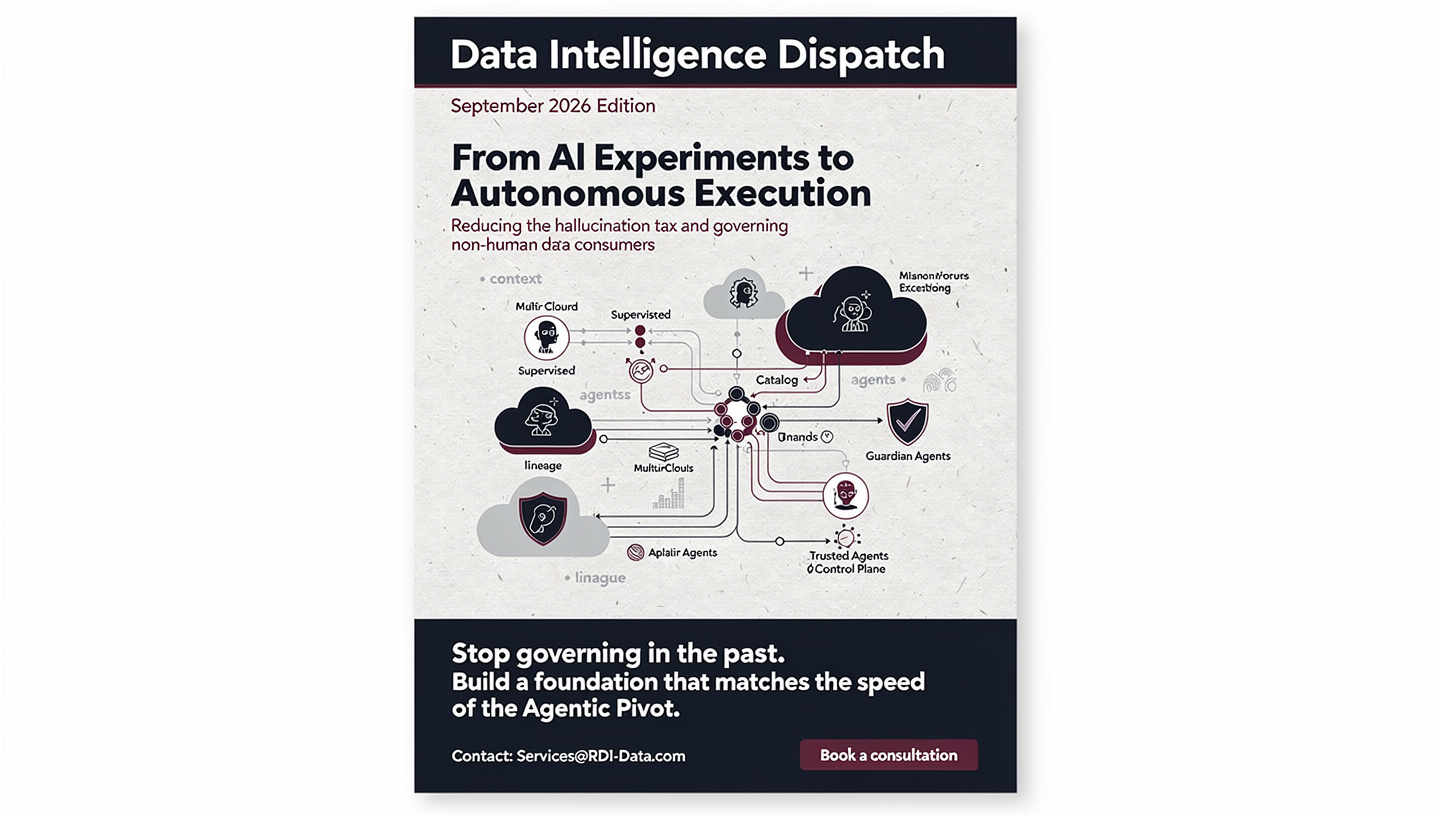
Welcome to the September 2026 edition of the Data Intelligence Dispatch. This past month marked a major turning point in enterprise data architecture as AI transitioned from pilot-phase experimentation into full-scale, autonomous agent execution.
The overarching theme of September 2026 is reducing the “hallucination tax” and governing non-human data consumers. As organizations deploy autonomous coding and operational agents across multi-cloud environments, the risk of agents reaching unverified, stale, or sensitive data has become the primary bottleneck to ROI. The top developments this month highlight how active context management, runtime supervision (Guardian Agents), agentless unstructured file discovery, and catalog-layer lineage are creating the trusted control plane needed for safe, high-velocity AI transformation.
The September 2026 Data Intelligence Dispatch outlines a decisive shift from passive metadata storage to active context management and runtime agent supervision. The common thread across this month’s major announcements—from Collibra’s Guardian Agents to Ohalo’s Data X-Ray for unstructured RAG context and Alation’s AIOS expansion—is that enterprise AI failure is rarely an algorithmic problem; it is a context problem. Organizations are responding by placing catalog-layer lineage and automated CI/CD review gates around non-human data consumers, ensuring that as autonomous agents generate code and execute business choices, they remain grounded in certified, auditable enterprise metadata.
The Breakthrough: Eliminating the “Hallucination Tax” with Guardian Agents & Active Context
As enterprise AI evolves from single-prompt chatbots into multi-step, autonomous reasoning agents, the financial and operational costs of error have escalated dramatically. When non-human data consumers execute multi-cloud API calls and code workflows independently, a single piece of unverified or stale context at step one propagates across the entire chain—amplifying token costs and creating severe operational risk.
The September 2026 Reality: You cannot govern non-human data consumers with human-speed, post-hoc approval workflows. Autonomous agents do not merely generate text—they execute actions across CRMs, financial systems, and unstructured document stores. To eliminate the “hallucination tax”—the compounding cost of tokens and downstream errors spent reasoning over low-quality or unauthorized context—enterprises are adopting active context platforms and Guardian Agents that supervise agent execution in real time outside the model’s reasoning loop.
Combining Guardian Agents with catalog-layer lineage and agentless file discovery enables real-time interception of unauthorized actions, keeping sensitive enterprise data protected while ensuring every autonomous decision remains fully auditable.
Govern Non-Human Data Consumers & Eliminate AI Risk with RDI
Refined Digital Insight (RDI) delivers the strategic frameworks, custom data engineering, and managed governance infrastructure needed to control non-human data consumers and eliminate the hallucination tax.
1. AI Readiness Plan & Enablement Service
To establish a secure, compliant execution boundary for autonomous agent fleets, RDI provides a structured enablement blueprint:
Strategic Alignment: We collaborate directly with your executive team and AI sponsors to align business goals, agent execution boundaries, and risk thresholds in writing.
AI Ecosystem Maturity Assessment: Our experts evaluate your multi-cloud data and tech landscape against RDI’s proprietary AI Reference Architecture model to identify security gaps and non-human consumer risks.
Actionable Framework Creation: We deliver a tailored AI Readiness Framework to guide sustainable agent deployment, runtime governance, and implementation priorities.
2. Custom DevOps Integration Service
To implement real-time Guardian Agent supervision, runtime policy enforcement, and catalog-layer lineage, RDI builds high-performance data backbones:
Process & Data Flow Assessment: We conduct thorough walkthroughs across IT, business, and data teams to evaluate streaming pipelines, multi-cloud boundaries, and agent access points.
Security & Compliance Mapping: RDI designs custom DevOps blueprints incorporating security-by-design principles, agent permission scoping, and real-time compliance tracking.
Zero-Downtime IaC Deployment: We deploy Infrastructure-as-Code (IaC) solutions with real-time performance monitoring, automated security alerting, and token efficiency analytics.
3. Collibra Managed Services: Active Context & Lineage Enablement
For enterprises leveraging Collibra to manage data catalogs and active context, RDI transforms your platform into a live runtime control plane:
Metadata Enablement (Tier 2): We automate metadata discovery across structured and unstructured estates using RDI connectors (up to 30 loads per quarter) to ensure context remains fresh for machine reasoning.
Tailored Value Services (Tier 3): We deliver customized quarterly deliverables—including Agent Contract integration, automated lineage tracking, and policy enforcement—aligned directly to your agentic AI roadmap.
Govern Your Agentic AI Estate Today
Don’t let regulatory enforcement or legacy governance frameworks halt your enterprise AI deployment. Partner with RDI to build automated, audit-ready context control planes operating at machine speed.
To get started, contact Services@RDI-Data.com or book a consultation directly with our discovery team
1. Collibra Launches Maestro, Live Map, and Guardian Agents to Reduce the Hallucination Tax on Enterprise AI
Business Driver: Mitigating the hidden operational costs, rework hours, and hallucination risks associated with moving enterprise AI from pilot programs into autonomous agentic execution.
Key Takeaway: Guardian Agents and Live Map provide runtime supervision, automated lineage mapping, and active governance controls that enforce policies directly at the moment AI agents access enterprise data.
Summary: On September 23, 2026, Collibra introduced three core capabilities: Collibra Maestro, Live Map, and Guardian Agents. Designed to reduce the “hallucination tax,” these tools bring real-time runtime supervision to enterprise AI agents, ensuring they consume certified context and adhere to strict corporate guardrails before executing decisions.
Link: Collibra Launches New Capabilities to Reduce the Hallucination Tax on Enterprise AI
2. Ohalo Data X-Ray: Harnessing Unstructured Data for AI Innovation
Business Driver: Unlocking the 80%+ of enterprise knowledge locked in unstructured document stores (SharePoint, S3, PDFs) without triggering severe privacy or regulatory violations.
Key Takeaway: Agentless, file-level discovery and classification can shrink model deployment timelines from months to weeks by stripping bad data, auditing entitlements, and preparing clean unstructured context for RAG workflows.
Summary: Featured on September 21, 2026, EM360Tech highlighted Ohalo’s Data X-Ray platform, showcasing how deep contextual analysis and relevance tagging make unstructured data RAG-ready. By scanning files in-place across S3 and SharePoint, Ohalo enables organizations to cut compliance exceptions by 80% and deploy production AI models safely in six weeks.
3. Alation Launches AIOS™ Expansion with Six Products to Accelerate AI Transformation
Business Driver: Overcoming the friction of managing fragmented data, context, and AI agents across distributed multi-cloud architectures.
Key Takeaway: Expanding the AI Data Intelligence System (AIOS) into AI Governance, Ontologies, Intelligent Feeds, Console, Governed Collections, and Semantic Model Mastering delivers unified, agent-ready context across the enterprise.
Summary: On September 17, 2026, Alation announced six major product additions to its AIOS platform. The release bridges data intelligence and agentic workflows, equipping data teams with semantic ontologies and governed collections so autonomous AI agents operate on certified enterprise knowledge rather than unverified inputs.
Link: Alation Launches AIOS™ Expansion with Six Products that Accelerate AI Transformation
4. Alation Named a Leader in 2026 IDC MarketScape for Worldwide Data Intelligence Platform Software
Business Driver: Evaluating and selecting comprehensive data intelligence platforms capable of supporting federated architectures and agentic AI.
Key Takeaway: Vendors with open federated architectures, native agentic AI support, and governed data product capabilities are establishing the modern enterprise standard for data intelligence.
Summary: Published on September 4, 2026, the IDC MarketScape named Alation a Leader in Worldwide Data Intelligence Platform Software. The evaluation highlighted Alation’s strengths in open federated metadata architecture and its ability to govern data products feeding both human analysts and autonomous AI agents.
Link: Alation Named a Leader in the 2026 IDC MarketScape for Worldwide Data Intelligence Platform Software
5. Enterprise Data Lineage: Where It Sits, Who Owns It, and What It Costs
Business Driver: Avoiding multi-million dollar regulatory fines and broken reporting pipelines by clarifying technical ownership and architectural placement of data lineage.
Key Takeaway: Lineage is an architectural layer, not a standalone product; placing lineage in the catalog layer provides the only cross-tool visibility spanning source databases, transformation layers, warehouses, and BI dashboards.
Summary: Published on September 9, 2026, this in-depth guide by Decube analyzes the four layers of the data stack where lineage capability resides. The report outlines why catalog-layer lineage is essential for cross-platform impact analysis and column-level compliance, emphasizing that successful programs treat lineage coverage as a test rather than a vanity metric.
Link: Enterprise Data Lineage: Where It Sits, Who Owns It, What It Costs
6. IBM Named a Leader in 2026 IDC MarketScape for Decision Intelligence Platforms
Business Driver: Transitioning from traditional passive analytics to decision intelligence platforms that orchestrate, explain, and optimize autonomous business decisions.
Key Takeaway: Competitive advantage in the AI era comes not from making decisions automatically, but from making better, trustworthy, and auditable decisions governed by business rules.
Summary: On September 16, 2026, IBM was named a Leader in the IDC MarketScape for Decision Intelligence Platforms. The report reinforces that as enterprises move toward agentic operations, unifying AI models with decision rules and optimization constraint logic is critical for auditability and ROI.
Link: IBM Named a Leader in the 2026 IDC MarketScape for Decision Intelligence Platforms
7. Who Governs Agent-Created Fabric Items? CI/CD and Audit Protocols
Business Driver: Closing the critical security and compliance gap created when AI coding agents commit code, pipelines, and database items directly into cloud environments without human review.
Key Takeaway: Governing “agent-authorship” requires integrating data catalog context layers with Git CI/CD branch policies, separating the identity that builds from the identity that ships.
Summary: Published on September 28, 2026, Atlan’s technical analysis examines the rise of non-human code authors in Microsoft Fabric. The guide presents a review framework for enforcing least-privilege roles, audit logging, and graduated human oversight before agent-created pipeline artifacts reach production.
8. Informatica IDMC Assurance Service September 2026 Release
Business Driver: Streamlining cloud migration and multi-tenant environment management by automating connection tests, agent comparisons, and configuration syncs.
Key Takeaway: Exposing public APIs for Agent Compare and Agent Sync transforms data pipeline governance from a manual maintenance chore into an automated, programmatic workflow.
Summary: Released on September 8, 2026, Informatica’s monthly IDMC release introduced new public APIs for Agent Compare, Agent Sync, and Connection Testing. These automation capabilities enable enterprise data operations teams to continuously monitor IDMC environments and guarantee configuration reliability across complex cloud architectures.
Link: Informatica Intelligent Data Management Cloud (IDMC) Assurance Service Release Notes
9. New Survey Finds 72% of Tech Decision-Makers Feel AI Initiatives Today Are Falling Short
Business Driver: Identifying the systemic root causes holding back enterprise AI return on investment (ROI) despite soaring corporate AI budgets.
Key Takeaway: Context verification is the hidden time sink; 87% of tech leaders burn hours manually re-verifying context for AI agents, and 76% hit major roadblocks moving pilot programs into production.
Summary: On September 16, 2026, Collibra released a Harris Poll survey revealing that despite massive investments, nearly three-quarters of decision-makers feel AI is underdelivering. The study underscores that lack of trusted, governed context—not model sophistication—is the primary bottleneck stalling enterprise AI execution.
Link: New Survey Finds 72% of Tech Decision-Makers Feel AI Initiatives Today Are Falling Short
10. Data Lineage Tools in 2026: Where Lineage Lives in Your Stack
Business Driver: Selecting the correct architectural altitude for data lineage to meet stringent compliance (EU AI Act, GDPR) and support RAG pipelines.
Key Takeaway: Context management is the evolution of data cataloging; lineage serves as one of the fundamental metadata streams that unifies human policies and machine access.
Summary: Published in September 2026, this strategic breakdown explains how data lineage has evolved from a simple governance checkbox into the backbone of enterprise “Context Management”. The guide walks through how event-driven ingestion and metadata propagation at column precision keep lineage current for continuous agentic operations.